



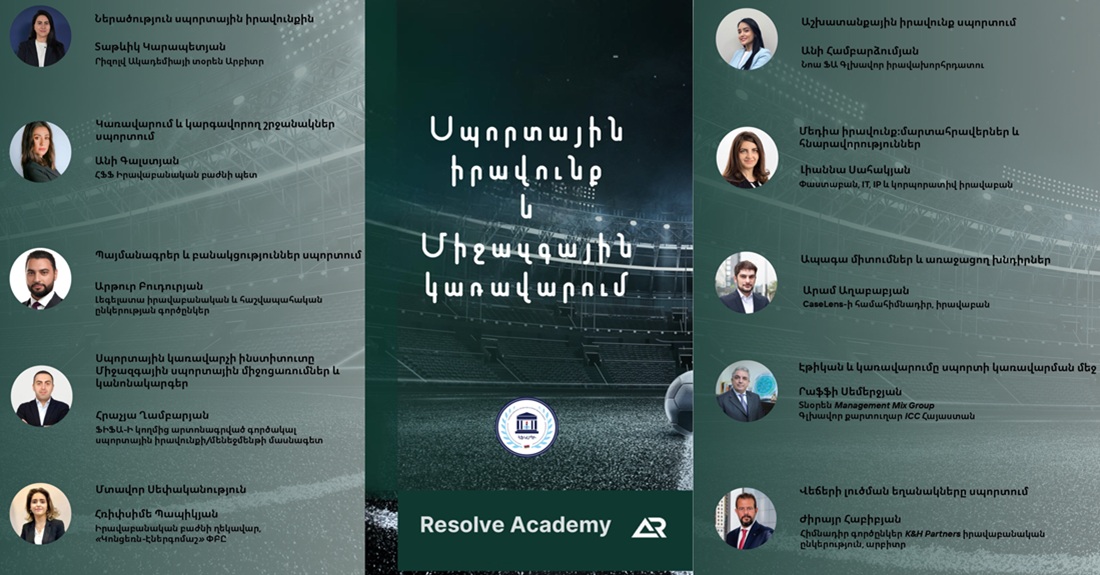
The Armenian State Institute of Physical Culture and Sport, in cooperation with Resolve Academy, runs courses on “Sports Law and International Management”, designed for lawyers and specialists in the field of sport.
The duration of the course is 10 hours. The course is structured on the following modules:
1. Introduction to Sports Law
• Overview of Sports Law: definitions, scope, and significance of the field.
• Sources of Sports Law: national laws, international conventions and regulations.
• Fundamental Legal Principles: contracts, torts, intellectual property, and labor law as applied to the sports sector.
2. Management and Regulatory Frameworks in Sport
• The role of governing bodies: FIFA, the IOC, UEFA, and others.
• Regulatory Frameworks: anti-doping regulations, athlete eligibility criteria, and disciplinary procedures.
• Ethical issues: fair play, integrity and sportsmanship.
3. Contracts and Negotiations in Sport
• Athlete Contracts: rights, obligations, and disputes.
• Agent Representation: role, responsibilities, and legal considerations.
• Negotiation Strategies: contract development and review.
4. Dispute Resolution in Sport
• Arbitration vs. Litigation: pros and cons.
• Court of Arbitration for Sport (CAS): structure and jurisdiction.
• Case Studies: landmark disputes and their resolutions.
5. Intellectual Property and Media Rights
• Trademarks and Licensing: protection of team logos, names, and merchandise.
• Broadcast and Media Agreements: rights distribution and revenue sharing.
• Digital Media: challenges and opportunities.
6. Employment Law in Sport
• Player Rights: transfers, contract termination and compensation.
• Discrimination Issues: gender, race and disability within sports employment.
• Collective Bargaining Agreements: negotiations and legal implications.
7. International Sport Events and Regulations
• Organizing Major Events: legal frameworks and procedural requirements for planning sport competitions.
• Safety and Security: legal obligations and risk management.
• Commercial Exploitation: sponsorship, advertising and marketing.
8. Ethics and Governance in Sport Management
• Corporate Governance: transparency and accountability.
• Ethical Criteria: codes of conduct and compliance standards.
• Risk Management: legal implications of crisis management.
9. Case Studies and Practical Applications
• Real-life Scenarios: analysis of legal issues arising from recent sports controversies.
• Role-playing Exercises: negotiation simulations and arbitration scenarios.
10. Future Trends and Emerging Issues
• Technology in Sport: virtual reality, data analytics, and e-sports.
• Globalization: cross-border transactions and legal challenges.
• Environmental Sustainability: green initiatives, regulatory considerations and their impact.
Participants will receive certificates upon successful completion of the course and knowledge assessment.